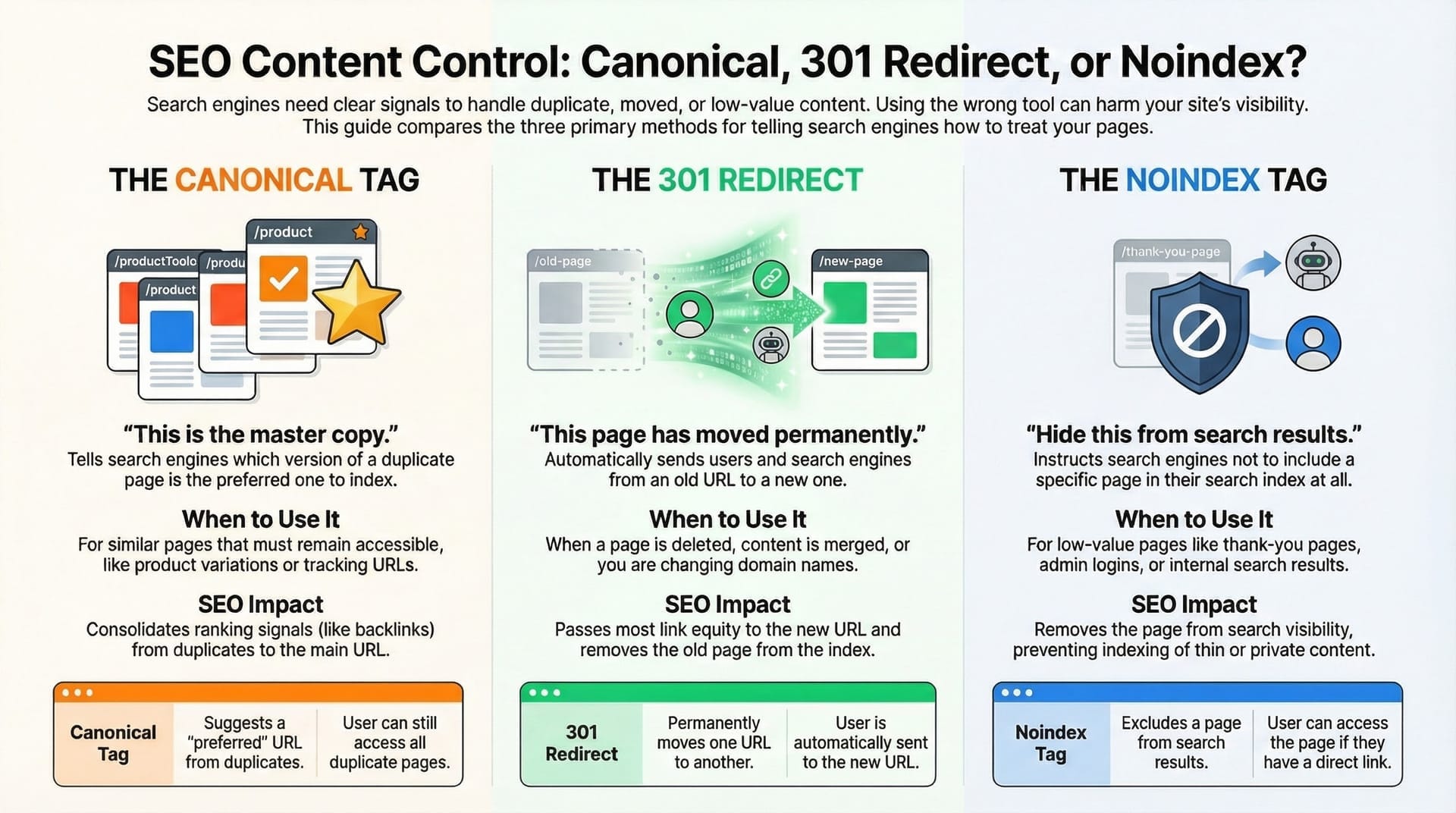
SEO Traffic Control
In large-scale web architectures, search engine crawlers act as high-speed navigators. Ambiguous or conflicting signals lead to wasted crawl budget, fragmented indexing, and reduced organic visibility. Achieving technical stability requires the alignment of six core mechanisms: canonical tags, permanent redirects, indexation directives, deletion status codes, maintenance headers, and caching signals.
The objective is to align HTTP Status Codes with HTML Metadata so search bots receive a single, unambiguous instruction.
Handling Pagination Series
Pagination remains one of the most frequent sources of near-duplicate content on e-commerce, blogs, and listing sites. Since Google fully deprecated rel="next"/"prev" (no longer used as signals), current best practices (Google Search Central, December 2025) focus on simplicity and crawlability.
Recommended approaches:
- Ideal: Implement a "View All" page containing the full series content on a single URL (if page load times remain acceptable, e.g., under 3–4 seconds). Then, canonicalize all paginated parts (page/2, page/3, etc.) to the "View All" URL.
- Strong alternative: Self-referencing canonicals on every paginated page (e.g., /category/page/2 canonicals to itself).
- Avoid canonicalizing all deeper pages back to page 1—it risks devaluing unique content on later pages and can cause Google to treat the series as one diluted entity.
- Never block pagination with noindex or robots.txt unless the pages add zero value (rare).
- Ensure paginated URLs are linked internally, included in sitemaps if valuable, and crawlable.
Additional tips: Use consistent URL structures (e.g., /page/2 vs. ?page=2—Google slightly prefers parameters for tracking in Search Console). Allow identical or similar title/meta descriptions across the series if content overlaps heavily.
Signal Strength Hierarchy: Prioritizing Redirects Over Canonicals
Google Search Central explicitly ranks redirects (301/308 for permanent, 302/307 for temporary) as the strongest signal for URL consolidation and canonicalization (updated December 2025).
In contrast, rel="canonical" tags are treated as hints, not directives.
Practical recommendations for large sites:
- Prefer redirects for any duplicate where the alternate URL no longer needs to serve unique user value.
- Use canonical tags primarily when duplicates must remain accessible and functional.
- Critical warning on noindex misuse: Never use noindex to "solve" duplicates.
Aligning with this hierarchy prevents common issues like "Duplicate, Google picked different canonical" reports in Search Console.
Permanent vs. Temporary Redirects
Redirects are server-level signals. Crawlers use them to understand whether the old URL is still the main one, or whether the new URL should replace it.
Permanent moves
Use a permanent redirect when the move is meant to stick. Google treats 308 as equivalent to 301 but prefers it for modern implementations.
- 301: the classic default for page moves.
- 308: permanent redirect with stricter client semantics.
Temporary moves
Use a temporary redirect when the change may revert. Google treats 307 as equivalent to 302.
- 302: temporary redirect.
- 307: temporary redirect with method semantics preserved.
Redirect Hygiene
Redirects work best when they are simple. Each extra hop adds latency and wastes crawl resources.
- One hop: Old URL → Final URL.
- No loops: A→B→A breaks both users and crawlers.
- Fix protocol/host chains: avoid multi-step normalization.
- Update internal links: point directly to the final URL.
- Update XML sitemaps: list only final URLs.
- Match intent: redirect to the closest equivalent page.
Indexation Directives and Maintenance
The noindex directive provides a surgical layer of control for pages that are useful to users but detrimental to search health.
In instances of technical failure or scheduled maintenance, the 503 Service Unavailable status acts as a vital safety net for site authority.
Overload Protection
Traffic control also means protecting your server.
- 503: planned downtime or temporary instability.
- 429: rate limiting / “too many requests”.
- 500: emergency failure.
Caching Signals
Caching signals matter because crawlers have limited time and bandwidth.
- What it means: “same content as last time.”
- Why it helps: saves bandwidth and server work at scale.
- What it is not: 304 is not an indexing boost.
Architectural Hierarchy & Audit
To keep your index clean, your signals should be consistent and follow a predictable order.
Signal hierarchy (highest to lowest)
- Gateway layer: robots.txt controls path entry/exit at crawl time.
- Response layer: HTTP status codes define the page’s technical state.
- Instruction layer: X-Robots-Tag and certain Link headers.
- Metadata layer: canonical and meta robots.
What this means in practice
- Status codes come first.
- Use headers for broad control.
- Use canonicals for duplication, not deletion.
- Avoid conflicts.
Apache vs. Nginx
Redirects, removals, and indexing headers are most reliable when they happen at the server edge.
What matters in practice
- Apache flexibility: .htaccess helps when you don’t have root access.
- Nginx predictability: centralized config, reload to apply.
- Performance reality (Apache): minimize .htaccess checks via AllowOverride None where possible.
Redirect semantics
Some user agents may change POST to GET on 301/302. Use 308/307 if you need method preservation.
Common SEO controls: Apache vs Nginx examples
1) Permanent redirect
# Apache (mod_alias)
Redirect 301 /old /new
Redirect 308 /old /new

# Nginx
location = /old { return 308 /new; }
2) Temporary redirect
# Apache (mod_alias)
Redirect 302 /promo /promo-new
Redirect 307 /promo /promo-new

# Nginx
location = /promo { return 307 /promo-new; }
3) Permanent removal
# Apache (mod_alias)
Redirect gone /expired

# Nginx
location = /expired { return 410; }
4) Keep content accessible but out of search results
# Apache (mod_headers)
<FilesMatch "\.pdf$">
  Header set X-Robots-Tag "noindex"
</FilesMatch>

# Nginx
location ~* \.pdf$ {
  add_header X-Robots-Tag "noindex" always;
}
5) Planned maintenance
# Apache (example)
RewriteEngine On
RewriteCond %{REQUEST_URI} !/maintenance.html$
RewriteCond %{DOCUMENT_ROOT}/maintenance.hold -f
RewriteRule ^.*$ /maintenance.html [R=503,L]
ErrorDocument 503 /maintenance.html
Header always set Retry-After "3600"
# Nginx (example)
if (-f $document_root/maintenance.hold) { return 503; }
error_page 503 @maintenance;
location @maintenance {
rewrite ^(.*)$ /maintenance.html break;
add_header Retry-After 3600 always;
}